How to Build an Amazing College List that Reflects Your Preferences and Priorities
How to Build a College List That Fits You: A Step-by-Step Guide

Struggling to build your college list? This step-by-step guide walks you through how to create a balanced, personalized list that reflects your goals, priorities, and what you really want in a college experience.
There’s a moment in every college journey when the excitement of dreaming starts to clash with the reality of decisions. Suddenly, you're staring at a list of 4,000+ colleges in the U.S. and thinking... how do I even begin?
The truth is, building your college list is about more than prestige or where your cousin’s roommate went. It’s about you—your priorities, your preferences, and your future. It’s about finding the places where you’ll thrive academically, socially, and personally.
Let’s break it down.
Step 1: Know Yourself Before Building Your College List
Before you Google a single school or ask Reddit for advice, pause. This starts with you.
Knowing yourself before you start researching colleges isn’t just helpful—it’s essential. Without a clear understanding of what you need to thrive, it’s easy to get swept up in rankings, opinions, and glossy marketing materials. You might end up building a list based on someone else’s definition of success instead of your own. But when you begin with you—your learning style, your values, your vision for the future—you’re more likely to find colleges where you’ll feel supported, inspired, and challenged in all the right ways.
Ask yourself:
What kind of learner am I?
Do I want small seminar-style classes or big lecture halls with stadium seating?
Do I need structure, or do I thrive with flexibility?
Am I seeking strong school spirit, research opportunities, career readiness… or all three?
Jot down your dealbreakers and your dream features. Your college list should be shaped around your needs—not the other way around.
If you need more questions to help you figure out what you want out of your college experience, see my full list here.
Step 2: Balance Your College List with Reach, Match, and Safety Schools
A well-balanced college list usually includes:
Reach Schools: You might get in, but it’s not a guarantee.
Target (or Match) Schools: Your academic profile is solidly within their typical range.
Likely (or Safety) Schools: You’re highly likely to be admitted.
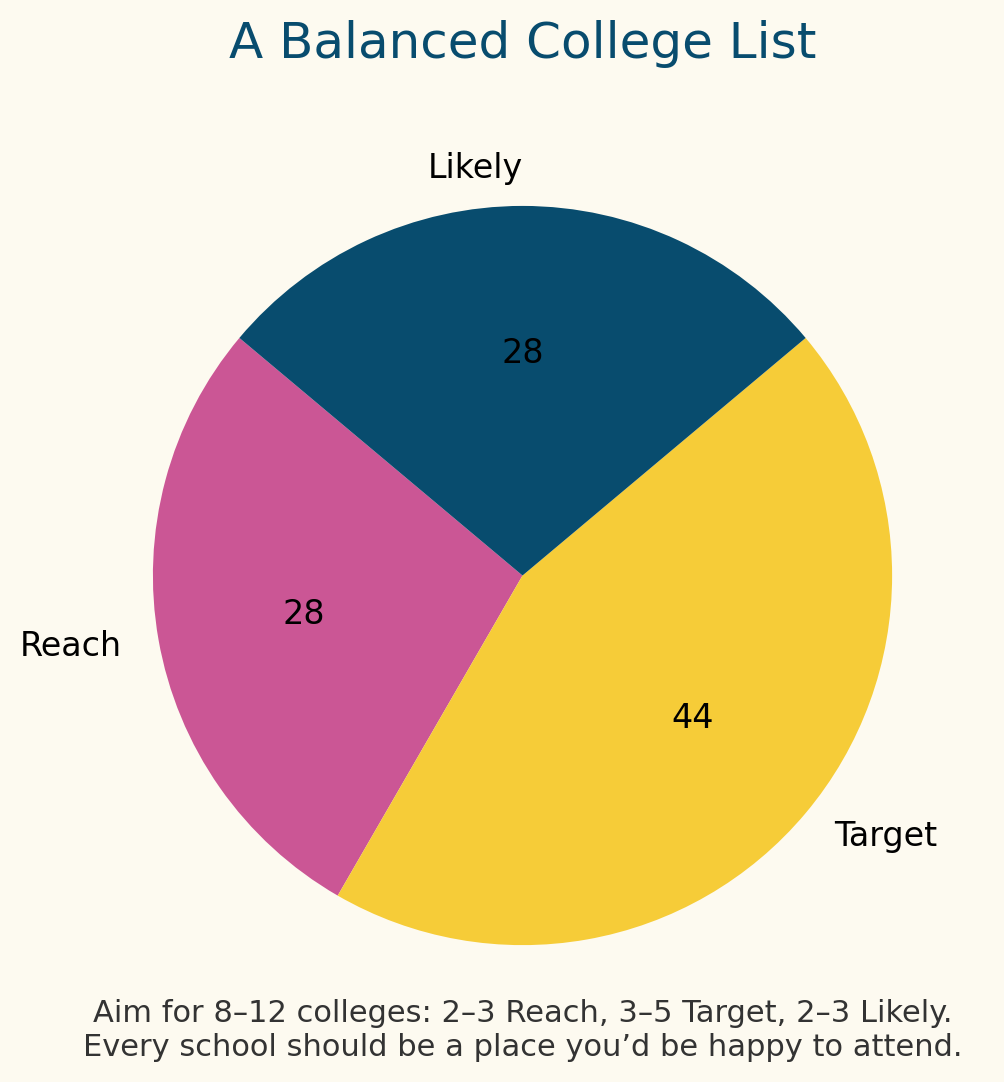
I recommend 2–3 reaches, 3–5 targets, and 2–3 likelies. Every school on your list should be a place you'd actually want to go. That means no “throwaways.”
Quick note about applying to too many schools:
If your list has 15+ schools, it’s worth asking—did you really take the time to research each one deeply? Are they all places you’d be excited to attend, or are some there “just in case”? Applying to too many schools can lead to essay burnout, unnecessary stress, and major application fees. It might also mean your list isn’t as focused or balanced as it could be. And if you’re applying to schools you’re not truly considering, it’s fair to ask: are you taking away a spot from someone who really is?
Step 3: Choose College Preferences That Reflect Your Priorities
Selecting a college isn’t about impressing a school enough to let you in—it’s about finding a place where you both belong. This isn’t a one-way street where colleges hold all the power. You’re evaluating them just as much as they’re evaluating you. A good college fit means the school aligns with your goals, values, learning style, and personality. You get to decide what kind of environment will help you thrive—and that decision holds power. Don’t just ask, “Will they pick me?” Ask, “Is this a place where I’ll be excited to show up every day?”
Think of building your college list like online dating. “Nice campus and good environment” won’t cut it—you need specifics.
Academic Fit
Do you want a structured core curriculum or an open curriculum with more freedom?
Is it important that your professors are focused on undergraduate teaching—or are you looking for top-tier research faculty?
Are you interested in interdisciplinary majors or dual-degree programs?
Campus Location & Vibe
Do you want to be in a big city with public transportation and job opportunities—or a quieter college town?
What kind of weather do you thrive in? (Yes, this matters—seasonal depression is real!)
Do you want a campus that clears out on weekends or one that’s full of events and school spirit?
Community & Identity
Is racial, cultural, or socioeconomic diversity important to you?
Do you want affinity groups or identity-based support centers?
Are you looking for a religiously affiliated campus—or one that’s completely secular?
Social Life
Do you want a party scene, or would you prefer a quieter campus culture?
How important is Greek life to your experience—essential, optional, or a no-thank-you?
Are there lots of clubs, student-led initiatives, or outdoor rec programs?
Career & Outcomes
Will you need access to strong pre-med, pre-law, business, or engineering advising?
Are you looking for schools with co-ops, internships, or strong alumni networks?
Is job placement after graduation a top concern?
Student Support & Wellness
Are mental health resources easily available and destigmatized on campus?
Do you want peer mentoring or strong academic advising programs?
How well does the school support students with learning differences or disabilities?
Financial Fit
Is affordability a top priority?
Do you need merit aid or schools that meet 100% of demonstrated financial need?Are you eligible for in-state tuition or tuition reciprocity programs?
The more specific you get, the more your list becomes yours. A great college list isn’t built on “what sounds impressive”—it’s built on “where will I grow, belong, and succeed?”
Pro Tip: Google “Common Data Set [College Name]” to find real stats on class size, demographics, test scores, and more.
Step 4: Use College Search Tools and People Who Can Help
Use platforms like:
College Board’s BigFuture
Niche.com for student reviews
College Navigator (from the U.S. Department of Education)
Your school counselor or independent consultant (hi, that's me!)
Remember, algorithms can suggest schools—but they can’t know your soul. Don’t rely only on filters. Use conversations, campus visits, and good old gut instinct to vet your options.
You don’t have to do this alone—and you definitely don’t have to rely on college brochures and random YouTube vlogs. Online platforms like BigFuture, Niche, and College Navigator let you compare stats, read student reviews, and explore programs all in one place. But don’t stop there. Talk to real people—your school counselor, a college advisor, current students, or alumni. These folks can offer insight you won’t find online, like what the vibe is really like, how supported students feel, or what surprised them most about their experience. Together, platforms and people can help you cut through the overwhelm and focus your search.
Step 5: When to Finalize Your College List (And When to Keep It Flexible)
In the early stages, your list is not final. It’s a brainstorm. You’ll add schools, remove schools, and change your mind (probably more than once).
That’s okay.
As you research more and (hopefully) visit campuses, your preferences might shift. Keep revisiting your priorities and updating your list accordingly. This is a living document.
In the early stages, your list is a brainstorm—not a contract. From winter of junior year through early summer, it should be flexible and evolving. This is your time to research, visit campuses (in-person or virtually), and reflect on what feels like a fit. By late summer—ideally before senior year starts—it’s time to narrow it down. Your final list should be ready by early fall so you can focus on writing essays, gathering materials, and meeting deadlines. If you’re applying Early Decision or Early Action, aim to lock in your list by early October. Remember: a strong list is one you feel excited about, not just one you’ve settled for.

Final Thought: This List is a Launch Pad, Not a Life Sentence
Where you go to college is important—but it doesn’t define your worth, your success, or your future. Think of your college list as a collection of possibilities. Each school you research teaches you something new about what matters to you.
And that’s the real win.
Want Help Creating Your List?
This is what I do every day with students—guiding them through structured brainstorming, targeted research, and list-building with heart and strategy. If you're feeling overwhelmed, or you just want a pro to double-check your list, let’s talk.
If you're looking for more info, head over to my website, Higher & Hire. And if you need help, just drop me a message here.
Many Thanks!
Valerie Palmer