
Applying to too many colleges often creates more stress than opportunity.
Every August, I see a familiar panic start to set in: students finalizing their college lists. And this year, one question has come up more than ever:
“Since the Common App lets me apply to 20 schools… shouldn’t I just go ahead and apply to 20?”
On the surface, it sounds harmless. More applications = more chances, right? But as someone who has worked in admissions, school counseling, and now as an IEC, I can say with confidence that applying to 20 schools is usually not a good idea—unless you have very specific extenuating circumstances.
Let’s break down why.
1. You Can Only Attend One College
This might sound obvious, but it’s worth saying: at the end of the process, you’re only going to attend one college. A list of 20 often signals that you didn’t spend enough time researching which schools are truly a good fit.
It’s far better to apply to 8–12 schools that you’ve researched deeply and could genuinely see yourself attending than to throw 20 darts at a board and hope something sticks.
So how do you know if a school is the right fit?

Visiting campuses—or researching virtually—helps students discover where they’ll truly fit and thrive.
Visit in person, if you can.
Nothing replaces walking around campus on an official tour, sitting in an info session, or even chatting with an admissions officer. Those experiences give you a real sense of the community and culture.
Use online resources if travel isn’t possible.
From virtual tours and student panels on YouTube, to school-run webinars and student blogs, there are more ways than ever to “visit” from your laptop.
Go beyond the brochure.
Look at course offerings, advising structures, internship pipelines, alumni networks, and campus organizations to see if what matters to you is actually available.
Taking this kind of time upfront makes it much easier to narrow your list—and ensures that every application you submit is one you’d be excited to accept.
2. Too Many Reach Schools = Too Much Heartache
Here’s what I see all the time: a student fills their list with “just-in-case” reach schools—often highly selective colleges with admit rates under 25%. On paper, it seems harmless: why not try, just to see?

Just because the Common App allows 20 schools doesn’t mean students should apply to all 20.
The problem is, when the decisions come in, the odds simply catch up—more reach schools on your list usually means more rejections, no matter how strong your application is. And when those rejections stack up, it can be emotionally overwhelming—especially when friends are celebrating good news.
That’s why balance matters. For every reach, make sure you’ve also included schools that are target and safety fits. The goal isn’t just to apply—it’s to have exciting options in the spring that celebrate who you are, not a string of rejections that leave you questioning your worth.
3. Rejections Often Hit Harder Than Expected
From both the admissions and counseling side, I can tell you: rejections aren’t just numbers. They sting. They affect how students view themselves and their worth.
When you’ve applied to 20 schools with 12 of them being reaches, the math just isn’t in your favor. Even if you get into 8-10 schools, the sheer volume of rejections can overshadow those wins and leave you feeling like you failed.
I’ve seen students lose confidence, question their abilities, and feel like their hard work wasn’t enough—when really, the problem was an inflated list. A balanced list not only boosts your odds of admission, it protects your mental health by ensuring that “yeses” are part of the equation.
4. Waitlists Aren’t Harmless
Many students argue: “If I get into a school I don’t want to attend, I’ll just decline. It doesn’t hurt anyone.”
But here’s the catch: when you accept an offer (or even just take a spot in the admitted pool), you may be bumping someone else to the waitlist. Colleges don’t keep infinite waitlists; they have limits. And if you’re “candidate 101” for a school that only holds 100 on the list, you may miss out simply because someone else applied “just to see.”
There’s also a timing issue. Getting admitted from a waitlist often happens in late April or even May. By then, students may have already committed elsewhere, put down deposits, or missed the chance to negotiate financial aid. In some cases, they’ll never get off the waitlist at all.
The ripple effects are real: every “just-in-case” application adds to the complexity for other applicants, for admissions offices, and ultimately for students making life-changing decisions.
The ripple effects are real: every “just-in-case” application adds to the complexity for other applicants, for admissions offices, and ultimately for students making life-changing decisions.
Who is most likely to be offered admission from a college’s waitlist? Students who help the college meet its enrollment goals. A college will admit from its waitlist to do things like:
– Balance gender
– Augment underenrolled academic programs
– Add desired diversity
These factors are outside your control. You can’t “plan” to get admitted from a waitlist, which is why it isn’t fair to assume that another student will simply take your place if you turn down an offer.
5. Extenuating Circumstances = The Exception, Not the Rule
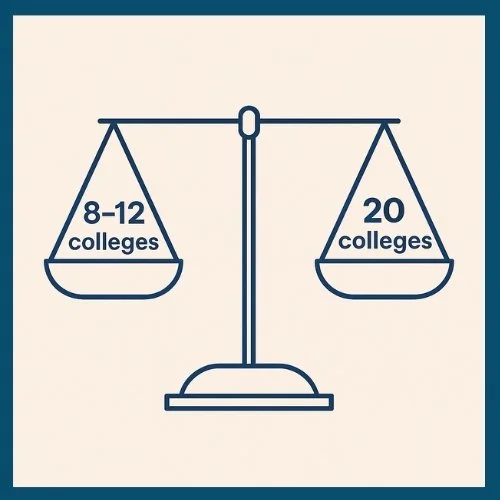
A balanced list of 8–12 schools gives students the best mix of safeties, targets, and reaches.
Are there times when a long list makes sense? Absolutely. For example:
Students applying to BS/MD programs alongside traditional pre-med tracks
Students with a big gap between GPA and test scores who want to spread their chances widely
Students navigating unusual or highly competitive situations (like audition-based programs or niche majors—and no, engineering isn’t a niche major, but motorsports engineering might be)
But for most applicants? 8–12 schools is plenty.
Other Reasons Not to Apply to Too Many Colleges
Beyond the emotional and strategic challenges, there are some very practical reasons why “applying everywhere” isn’t a good idea:
Application fees add up. Most schools charge $50–$90 per application. Multiply that by 20, and it’s not pocket change.
Supplements take time. Many colleges require unique essays or short-answer responses. These aren’t optional, and they deserve careful attention.
Generic applications don’t work. Admissions officers can tell when an essay is vague or recycled. Strong applications show intentionality—your understanding of why the college is a good fit for your background, interests, and goals.
More applications ≠ better odds. Selective admissions isn’t a lottery. Applicants are compared to the college’s standards and to each other. Quality matters far more than quantity.
How to Build a Strong College List
If 20 schools isn’t the answer, then what is?
The goal is to create a balanced list of schools where you’ll not only be admitted, but also thrive once you’re there. Here are some things to keep in mind:
Balance is key.
A healthy list usually has a mix of safety, target, and reach schools. (And remember: if a college admits fewer than 25% of applicants, it’s a reach for everyone—even students with near-perfect GPAs and test scores. That’s not a reflection of your worth, just the math.)
Know your profile.
Take an honest look at your academic record (GPA, test scores, course rigor), your extracurricular involvement (leadership, depth, impact), and even your geographic profile (colleges do consider where you’re from).
Think beyond numbers.
Highly selective schools also look for qualities like intellectual curiosity, collaboration, consistent engagement, and a clear sense of impact. How you present these elements matters just as much as your stats.
Do your research.
Each school on your list should be one where you could realistically see yourself enrolling. That means more than liking the campus photos—it means looking into majors, advising, culture, affordability, and community fit.
A strong list doesn’t just maximize your chances of admission; it ensures that when those acceptance letters roll in, you’ll have real choices that align with who you are and what you want from your college experience.
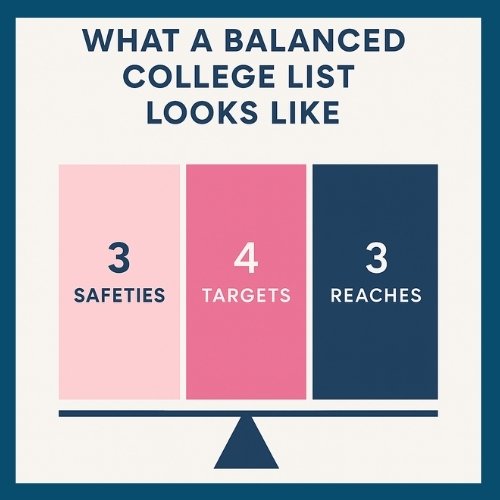
A balanced list means 8–12 carefully chosen schools—not 20 scattershot applications.
The Bottom Line
Applying to 20 colleges isn’t a strategy—it’s a scattershot approach that often creates more stress, more rejections, and more unnecessary work (and cost) than it’s worth. At the end of the day, you can only attend one school, and the goal should be to build a thoughtful, balanced list of places where you’ll thrive.
A strong list isn’t about numbers—it’s about fit, intentionality, and balance. Whether that means visiting campuses, digging into online research, or reflecting on how your academic and extracurricular profile aligns with a college’s values, the real work happens long before you hit “submit.”
Takeaway for families: Resist the temptation to max out the Common App just because you can. Focus instead on building a list of 8–12 schools that balance safeties, targets, and reaches, reflect your goals and strengths, and represent places you’d be genuinely excited to attend—without relying on unpredictable waitlists.
If you need a deeper dive into how to create that kind of list, check out my full guide here.
If you're looking for more info, head over to my website, Higher & Hire. And if you need help, just drop me a message here.
Many Thanks!
Valerie Palmer