Two optional sections, one big opportunity to provide context.
How to Use the New Common App “Additional Information” and “Challenges & Circumstances” Sections
Every year, students ask, “Where do I explain the additional extracurriculars I participated in or how my health struggles impacted my academic success on my application?”
In past years, there wasn’t always a good place for that. But as of August 2025, the Common App introduced two new optional short-answer sections—Additional Information and Challenges & Circumstances—that give you space to provide context, not essays.
If you’re wondering whether you should use them (and how), here’s your guide.
But First, Let’s Talk About “Optional”
But before we go any further, let’s clear something up: optional doesn’t always mean optional.
In college admissions, I’m usually the first to say “optional isn’t optional”—because 99% of the time, that’s true. Optional essays? Write them. Optional interviews? Schedule them. Optional tours? Go.
But this time is different. These two Common App sections are the rare exception where optional actually means optional.
If you don’t have anything new, relevant, or truly helpful to add, skip them. Don’t force it. Admissions officers are real humans with hundreds of files to read—and you don’t want to be the applicant who adds more words without more meaning. Think of it as a kindness to your reader (and to your own sanity), which will help you keep them on your side when making final decisions.
The New “Challenges & Circumstances” Section (250 words or less)
Let’s start with the one that tends to make everyone nervous. This section replaced the old “Community Disruption” question, but it serves a similar purpose: to help colleges understand any real-life stuff that’s affected your academics or extracurriculars.
Think of it as the context box, not the confession box.
You might use it to explain things like:
Limited access to advanced or AP/IB classes
A semester affected by illness, injury, or a big family responsibility
Switching schools (or school systems) mid-year
Taking care of siblings, working to support your family, or managing a parent’s illness
A major community disruption—natural disaster, strike, conflict, you name it
The key? Keep it short, factual, and focused on impact. You’re not writing a personal statement sequel, and this isn’t the place to pour your heart out about everything that’s ever been difficult. Admissions officers are looking for context, not catharsis.
Pro tip: there’s a formula for this.
Think of your response like a quick equation:
The Facts + The Impact + Your Response = A Complete Answer
In other words:
The Facts: What happened? (Keep it brief)
The Impact: How did it affect your academics, involvement, or opportunities?
Your Response: Did you take any steps to adapt, recover, keep moving forward, or learn from the experience?
That’s it. No need to dress it up or turn it into a mini-essay. The goal isn’t to impress—it’s to inform.
If it helps, ask yourself: Would this make someone reading my application say, “Ohhh, that explains it”? If yes, include it. If no, close the tab, grab a snack, and move on with your day.
When not to use it: Don’t repeat activities, copy your résumé, or include minor details that don’t add clarity or value. If it doesn’t strengthen your reader’s understanding of your path, leave it out.
The “Additional Information” Section (300 words or less)
If the Challenges & Circumstances section is about context, this one is about bonus context—the helpful, interesting, or impressive details that didn’t quite fit anywhere else in your application.
Think of it as your “drawer of useful extras.” You don’t need to fill it, but if there’s something meaningful inside—something that helps the admissions reader see you more clearly—this is the spot for it.
You might use this section to:
Explain something unique about your school’s grading system (like narrative evaluations or no GPA weighting).
Describe extra coursework, online classes, or research projects you’ve done beyond your regular schedule.
Highlight maker projects or creative work—whether that’s an engineering build, coding project, original composition, or design portfolio.
Include links to creative or published work (like blogs, short films, or op-eds)—just remember to add a quick description, since most readers won’t click the links.
Share a quick note about a manuscript, screenplay, or other independent creative project.
Add additional awards, scholarships, or honors that didn’t fit elsewhere, especially if they’re connected to your intended major or a particular college.
Clarify important details about your activities that wouldn’t fit in the Common App’s limited character counts.
Basically, this section is your space to showcase your academic curiosity, creativity, or initiative—without repeating what’s already covered. Keep it short, clear, and informative.
Here’s a simple test: if your addition helps the reader say, “Oh, that gives me a better picture of who this student is,” include it. If it’s just extra noise, skip it and give yourself a gold star for knowing when to stop.
Pro tip: Unlike the Challenges & Circumstances section, there’s no magic formula here. Really—anything goes (within reason). Use your imagination, show your curiosity, and let this section reflect you. If it’s relevant, clear, and true to your story, it belongs.
When not to use it: Don’t paste your résumé, repeat your activities, or cram in filler content just to look busy. Admissions officers appreciate insight—but they also appreciate applicants who value their time.
How the Two Sections Work Together
Think of these two as complementary but distinct:
Challenges & Circumstances
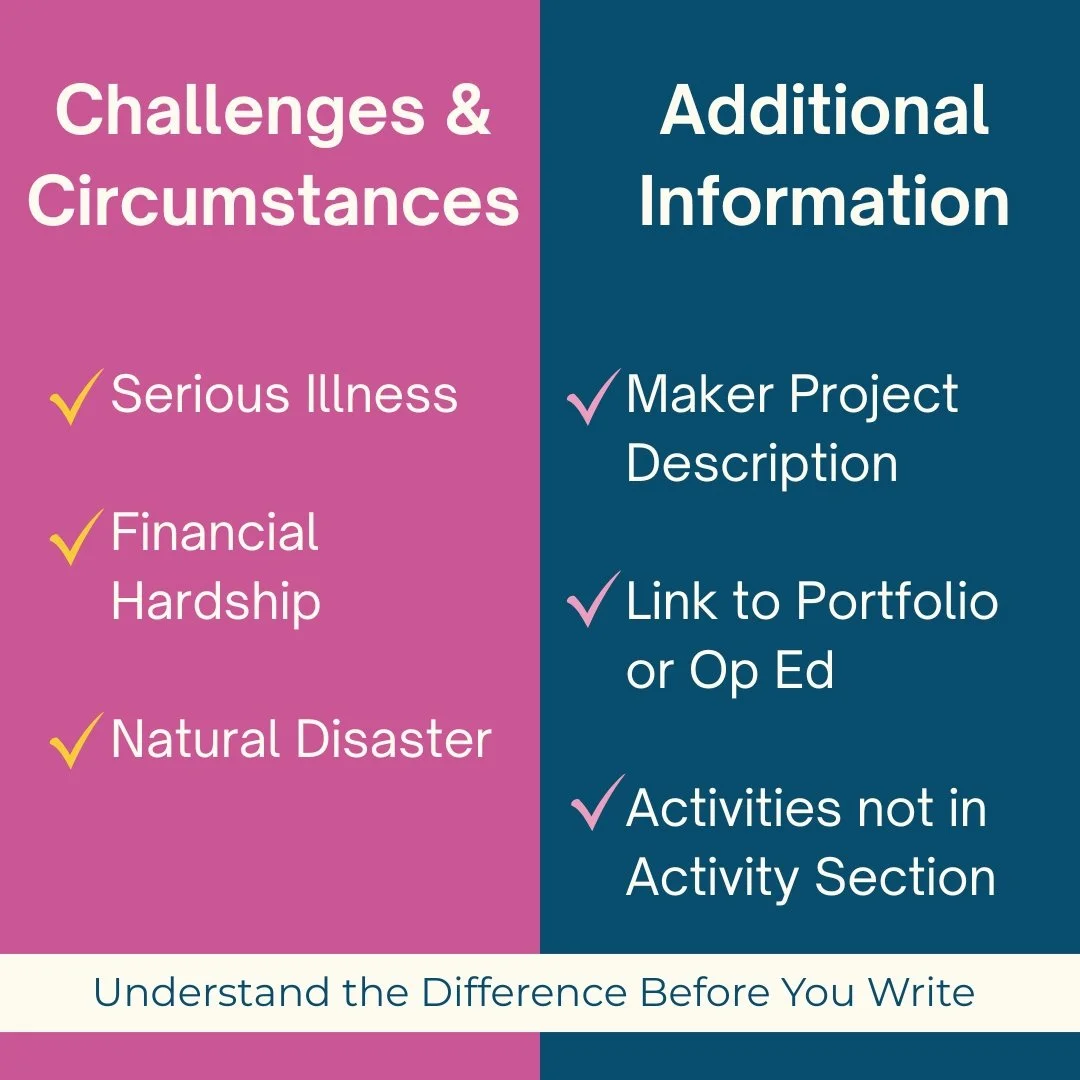
Understand the difference before you write.
Purpose: Explains disruptions, limitations, or hardships that affected your academics or activities
Length: 250 words
Tone: Objective, factual
Examples Illness, family responsibilities, school policy limits
Additional Information
Purpose: Adds context or enrichment that doesn’t fit elsewhere
Length: 300 words
Tone: Informative, concise
Examples: Research project, grading system, independent coursework
You don’t have to use both—but if you do, make sure they don’t overlap.
Quick Tips for Both
Keep it short and scannable. Admissions readers move quickly. Bullet points are fine.
Stick to facts, not feelings. Let the situation speak for itself—avoid emotional storytelling.
Don’t duplicate content. If your counselor already explains it, you don’t need to.
Focus on clarity and context. Ask yourself: Does this help the reader better understand my application? If not, skip it.
Proofread like you would any other essay. Even short answers deserve clean writing.
Want to make sure the rest of your application is just as strong? Check out my post on the Top Five Common Pitfalls in College Applications—and How to Avoid Them. It’s a quick read that could save you from some of the most common (and preventable) mistakes students make.
Final Thoughts
Optional doesn’t mean unnecessary—but it also doesn’t mean required.
If you have something that truly adds context or clarity, use these sections strategically. If not, leave them blank.
Remember: Admissions officers want insight, not extras.
If you’d like help deciding what to include or how to word it effectively, Higher & Hire offers personalized guidance on every part of your Common App.
If you're looking for more info, head over to my website, Higher & Hire. And if you need help, just drop me a message here.
Many Thanks!
Valerie Palmer