Holiday Break Is a Secret Weapon for Seniors (If You Use It Well)
What Seniors Should Actually Do Over Holiday Break for College Applications

A student uses the quiet of winter break to reset and refocus during the college application season.
By the time the pumpkin pie leftovers disappear, most seniors fall into one of three groups:
Group 1: The “I submitted my ED/EA/UC apps, and now I don’t know what to do with my hands” crowd.
Group 2: The “I still have 11+ schools to apply to, and my brain is a soup of deadlines, drafts, and panic” crew.
Group 3: The “I didn’t apply early, and now I feel behind even though everyone keeps telling me I’m not” humans.
No matter which group your student falls into, December has a very particular energy. It’s a mix of relief, exhaustion, self-doubt, and that weird limbo feeling of Shouldn’t I be doing something?
Here’s the truth I wish more students knew:
Holiday break is your quiet superpower — if you use it intentionally.
Not aggressively. Not obsessively. Just intentionally.
Below is a guide for how seniors can use winter break to reset, recharge, and move their applications forward without sacrificing actual rest (or peppermint hot chocolate).
1. First: Let your nervous system exhale — if your foundation is in place.
A lot of advice out there says, “Take a break! You’ve earned it!”
And yes — rest matters.
But here’s the honest truth I’ve learned from years of supporting seniors:
You can only rest once your foundation is complete.
Foundation =
Your application accounts are created
Your personal information and academics are filled out
Your Activities List is drafted (even if it still needs polishing)
Your recommenders are added
Your testing decisions are made
Your basic list of RD schools is outlined
If those pieces are done?
Yes. Absolutely. Breathe.
Before you touch a single essay, give yourself permission to rest. A day. A weekend. A stretch of time. Something.
But if you’re heading into mid- or late-December without any of those pieces in place, then the kindest thing you can do for yourself is this:
Take a short, intentional pause, not a vacation.
Rest just long enough to clear the mental fog.
Then get your foundational pieces in place so the rest of your application work has a structure to sit in.
A brief reset is helpful.
A long break before anything is started?
That’s what leads to overwhelm, panic, and all-nighter essays on December 30th.
So yes:
Let your nervous system exhale, but only once you’ve given your future self the basic scaffolding to stand on.

A quick winter-break checklist to help students confirm their application foundation before taking a rest.
2. Then: Get honest about what your early applications tell you, and what they don’t.
Whether early results have started rolling in or you’re still refreshing portals, here’s something important:
Early results are not a crystal ball — they’re a compass.
They don’t predict the future, but they do give you information you can use to adjust your Regular Decision strategy.
Here’s what we should take from early decisions:
An early acceptance doesn’t mean you should abandon every other application.
A deferral doesn’t mean you’re doomed.
A denial doesn’t mean your list is broken.
Not applying early at all doesn’t mean you’re “behind.” Many students apply for regular decision only- you are not alone!
If you have early cycle decisions, making small pivots now can save enormous stress in January.
Here’s how:
If you were accepted early…
Congratulations. Truly.
But also: don’t immediately throw the backpack into the air and abandon every other application.
Ask yourself:
Does the offer come with a financial aid package that works?
Are there any schools with significantly better academic, financial, or personal fit?
Do I want options in the spring, or am I certain this is my place?
Small pivot:
Finish at least 1–2 additional applications — not because you “should,” but because options give you power.
If you were deferred or waitlisted…
A deferral is not a soft rejection — it’s an invitation to stay in the conversation.
But it does signal that your application is competitive but not yet a clear admit.
Ask:
Does my Activities List fully reflect my impact?
Do my essays feel like they genuinely sound like me?
Does my academic profile align with this school’s typical admits?
Do I have a truly balanced list?
Did my early essays reflect my best writing? If not, what needs strengthening?
Small pivot:
Strengthen your RD essays, especially your storytelling and specificity.
Add 1–2 schools with slightly higher admit rates but similar vibes.
Prepare a thoughtful letter of continued interest (if the school accepts one).
These tweaks aren’t overhauls — they’re refinements.
If you were denied…
Painful? Yes.
A disaster? No.
A sign that your entire strategy is flawed? Also no.
A denial usually means one of two things:
The school was a reach.
The school wanted something in their class profile that you can’t control (major, demographics, institutional priorities).
Small pivot:
Add or re-evaluate a few target-level schools where your academics and activities fall directly in the heart of their typical profile.
Replace emotion-based choices (“this school feels sparkly”) with data-informed decisions (“I have a realistic shot here AND it fits me”).
Small shifts in your college list can drastically reduce stress in January.
If you didn’t apply early at all…
You are not behind. You’re on the Regular Decision timeline — the same one most applicants use.
But: do not let others’ early results pressure you into panic-applying to places you don’t actually want to attend.
Small pivot:
Refocus your energy on building a balanced list (reach/target/likely) now, not on December 28th. If you need to know how to build a balanced list, read this blog post.
Invest time in researching your top-choice schools so your RD essays have depth and specificity.
Use holiday break as your “early” — frontload the work instead of waiting for January.
Small, clear steps now prevent large, chaotic steps later.
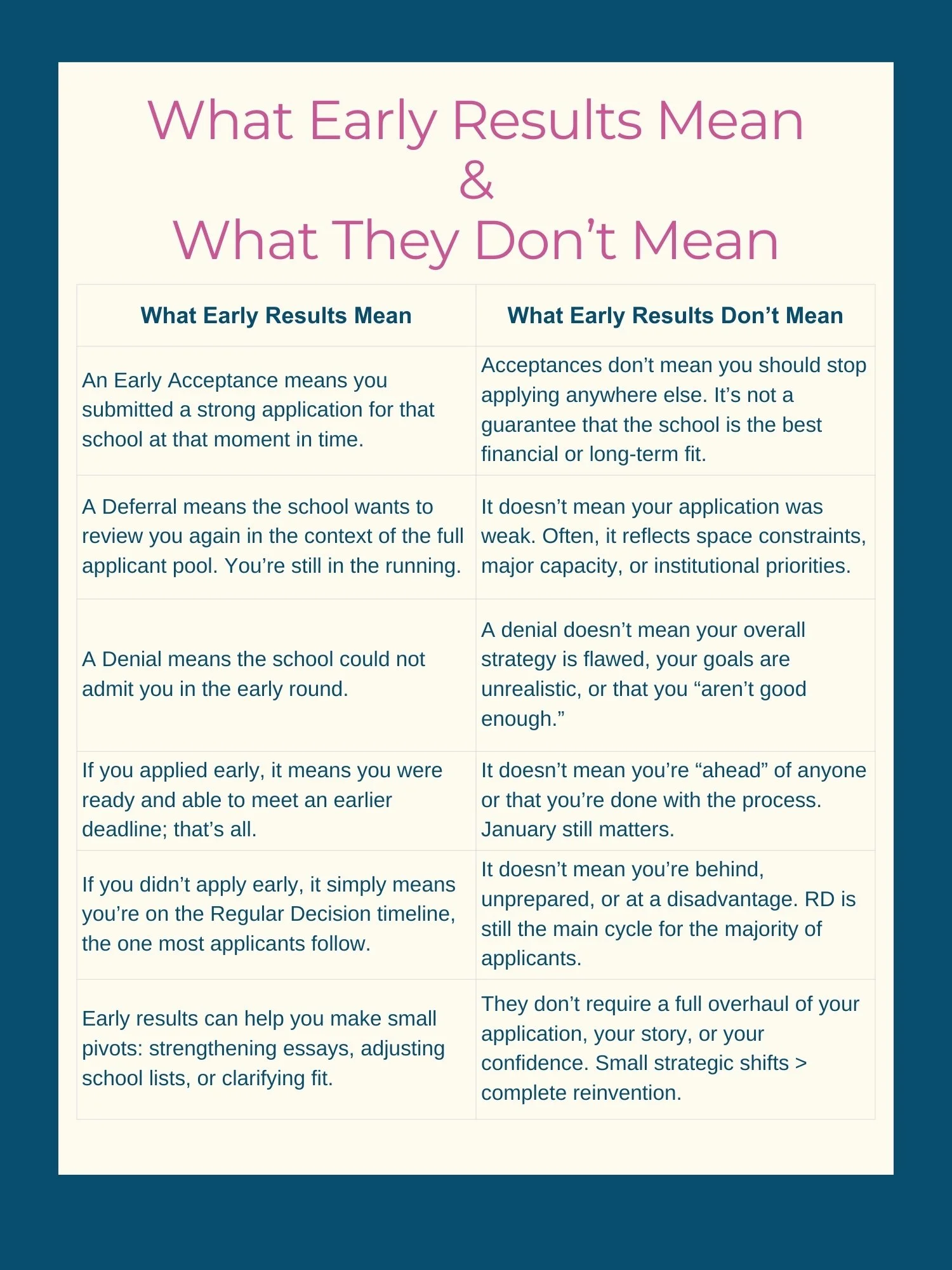
A simple guide to understanding what early admissions results truly indicate—and what they don’t.
Pro Tip for Application Adjustments:
You don’t need a dramatic overhaul of your applications — just informed micro-adjustments.
A 5% pivot now can lead to a 50% reduction in stress (and a 100% increase in clarity) in January.
3. Create a simple December → January game plan you can actually follow.
Most seniors think the biggest threat to their applications is running out of time. But in reality?
It’s the lack of a plan.
When you don’t create a clear December → January roadmap, here’s what usually happens:
Deadlines sneak up faster than expected
Essays start blending together
Students panic-add schools they don’t actually want
Parents become stressed because no one knows what’s been done
Students lose track of portals, transcripts, passwords, and requirements
Suddenly everyone is awake on December 30th asking, “Wait… what else is due?”
A simple plan eliminates all of that.
It puts you back in control.
Winter break is the perfect time to pause, zoom out, and sketch a practical, doable structure for the next few weeks. This isn’t about micromanaging yourself — it’s about removing decision fatigue.
Because every time you sit down to work without a plan, your brain has to ask:
Where should I start? What’s most important? What’s due? Is this the right thing to be working on?
And that constant mental switching burns energy you could be using to write strong, intentional essays.
A good December → January plan does three very important things:
1. It reduces overwhelm.
When you see your tasks divided into Must / Should / Could, you stop treating everything like a crisis. You know what matters most, what can wait, and what is genuinely optional. It’s like clearing a mental desk that’s been covered in sticky notes.
2. It prevents last-minute emergencies.
A plan helps you avoid the most common January disasters:
Your counselor is out of office when you suddenly need a transcript
A college portal reveals an unexpected supplemental essay
A major-specific program has a deadline sooner than the main application
A scholarship opportunity is missed because no one checked the fine print
Most of these headaches are totally preventable with a plan.
3. It lets you work in small, manageable chunks (instead of marathon sessions).
Students write significantly better essays when they work in short, consistent bursts. A plan allows you to be done with applications in 30–60 minutes a day instead of trying to conquer everything in one afternoon.
This is especially important over winter break, when you want (and deserve) rest, but rest feels impossible if your brain keeps whispering, “I'm behind… I should be doing something… what am I forgetting?”
4. It reduces conflict at home.
Parents want to support you. You want independence.
A plan gives everyone clarity about what’s happening when, which means fewer reminders, fewer misunderstandings, and fewer tense “Have you finished your essays yet?” conversations.
5. It increases confidence going into January.
January is typically the most stressful month of senior year.
But when you enter it with structure — knowing what’s done, what’s coming, and how you’ll manage it — the entire experience shifts. You move from reactive stress to purposeful action.
Use the Must / Should / Could Framework
You don’t need a complicated spreadsheet — you just need clarity. Try organizing your tasks with this simple three-part system:
A. Must-Do Items (non-negotiable)
These include:
Completing all required supplemental essays
Sending test scores (if applicable)
Confirming transcript requests
Completing major-specific portfolios (for arts/architecture)
Updating your Activities List if it feels rushed or unclear
B. Should-Do Items (important, but flexible)
These include:
Revising earlier essays based on what you’ve learned
Writing optional essays (when they’re actually helpful) - if you need help with this, check out my blog post on how to use the two optional essays to optimize your application
Researching colleges more deeply to write better “Why Us?” responses
C. Could-Do Items (nice but not essential)
These include:
Pre-writing scholarship essays
Tidying your résumé for merit programs or honors colleges
Updating your recommender with any major wins
Once you’ve sorted tasks into these buckets, you’ll suddenly feel more in control, without adding pressure.
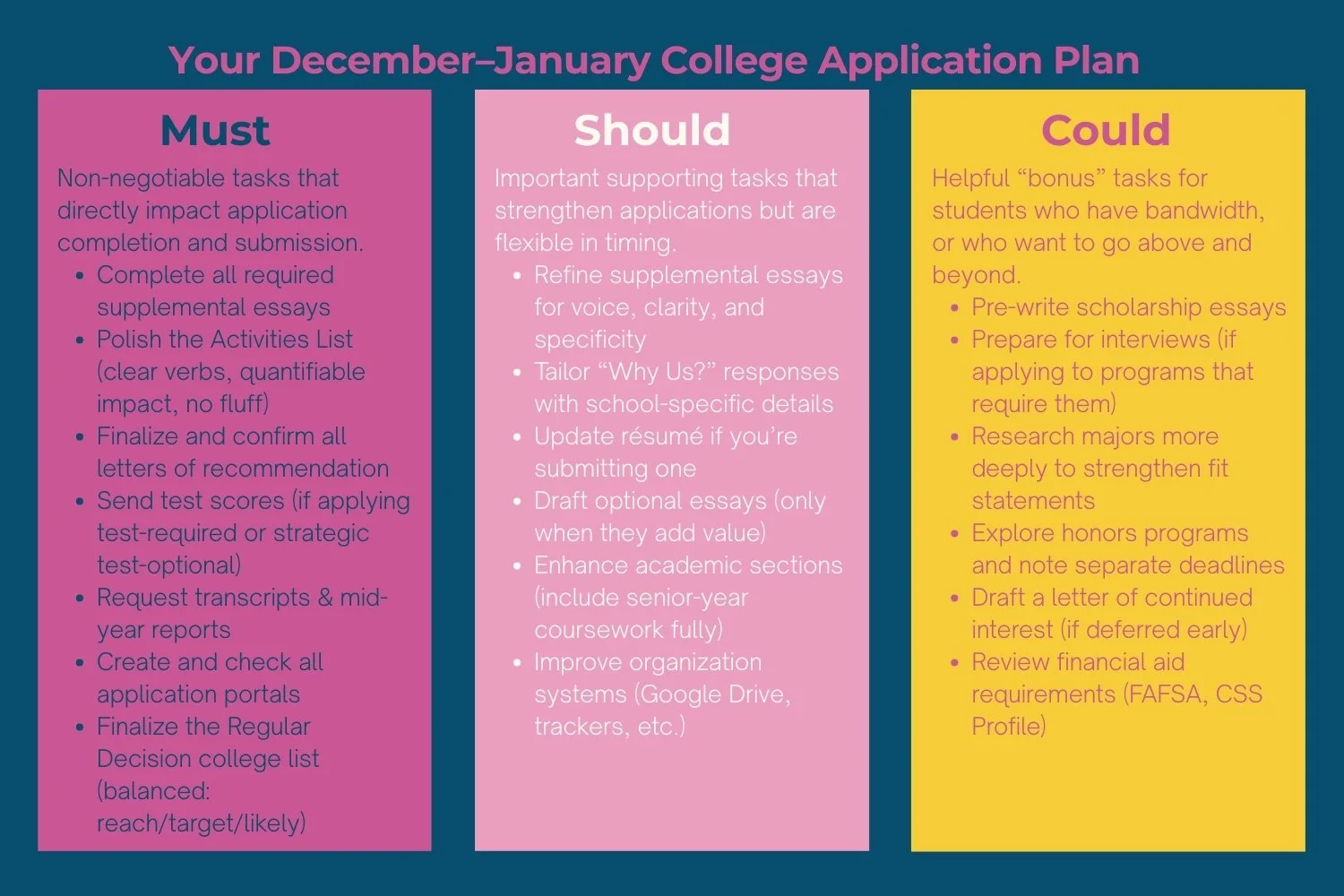
A visual breakdown of what seniors must, should, and could do over winter break to stay on track for Regular Decision deadlines.
4. Break your work into small, holiday-friendly chunks.
You do not need to spend your holiday break writing essays for 6 hours a day. Try this instead:
30 minutes: Brainstorm ideas for a supplemental prompt
45 minutes: Draft a rough outline
25 minutes: Tweak a paragraph in your personal statement
20 minutes: Update your Activities List verbs
1 hour: Research 1–2 schools more deeply
Think of it like mini-workouts: short, intentional bursts that keep your momentum going without exhausting you.
You can even design a “3-Day RD Sprint” for the days after Christmas, when the glow of gift-wrap fades and you’re looking for structure.
5. If you didn’t apply early: release the shame. Honestly.
I promise you this: Regular Decision is normal. Millions of students apply to Regular Decision every single year. And yes, there are other students who are only applying to Regular Decision.
There are so many reasons families skip early deadlines:
Needing more time on essays
Needing more clarity on college fit
Needing fall grades to boost the academic picture
Needing more financial aid information
Needing emotional readiness
You are not behind. But the Holiday break can give you the space to do this thoughtfully (even beautifully).
6. Watch out for December/January comparison culture.
December is prime time for:
Group chats filling with acceptance screenshots
Parents comparing students at holiday parties
Friends panicking because “everyone’s hearing already”
Social media making you feel like the last unclaimed college applicant on Earth
Here’s the antidote: Your timeline is your timeline.
And the work you do over break, calmly, clearly, without panic, will matter far more than someone else’s news in someone else’s house.
7. End your break with a “Launch Into January” checklist.
Here’s a short version your students can follow:
Finalized list of RD schools
All portal accounts created
Activities List updated and polished
1–2 strong templates ready for “Why Us?” essays
Drafts complete for schools with Jan 1–5 deadlines
Recommendation reminders sent (if needed)
FAFSA/financial aid docs organized
A plan for the first week of January (not the first hour)
If you hit most of these, you’re in excellent shape.
Final Thought: Your Break Is a Bridge — Not a Finish Line
Holiday break shouldn’t be a productivity contest. It should be a way to cross from Fall Chaos to January Clarity without burning out.
Whether you applied early, didn’t, or are still figuring things out, winter break gives you something rare in the admissions process: A pause button and a reset button — at the exact same time.
Use both. And use them with intention.
If you're looking for more info, head over to my website, Higher & Hire. And if you need help, just drop me a message here.
Many Thanks!
Valerie Palmer